
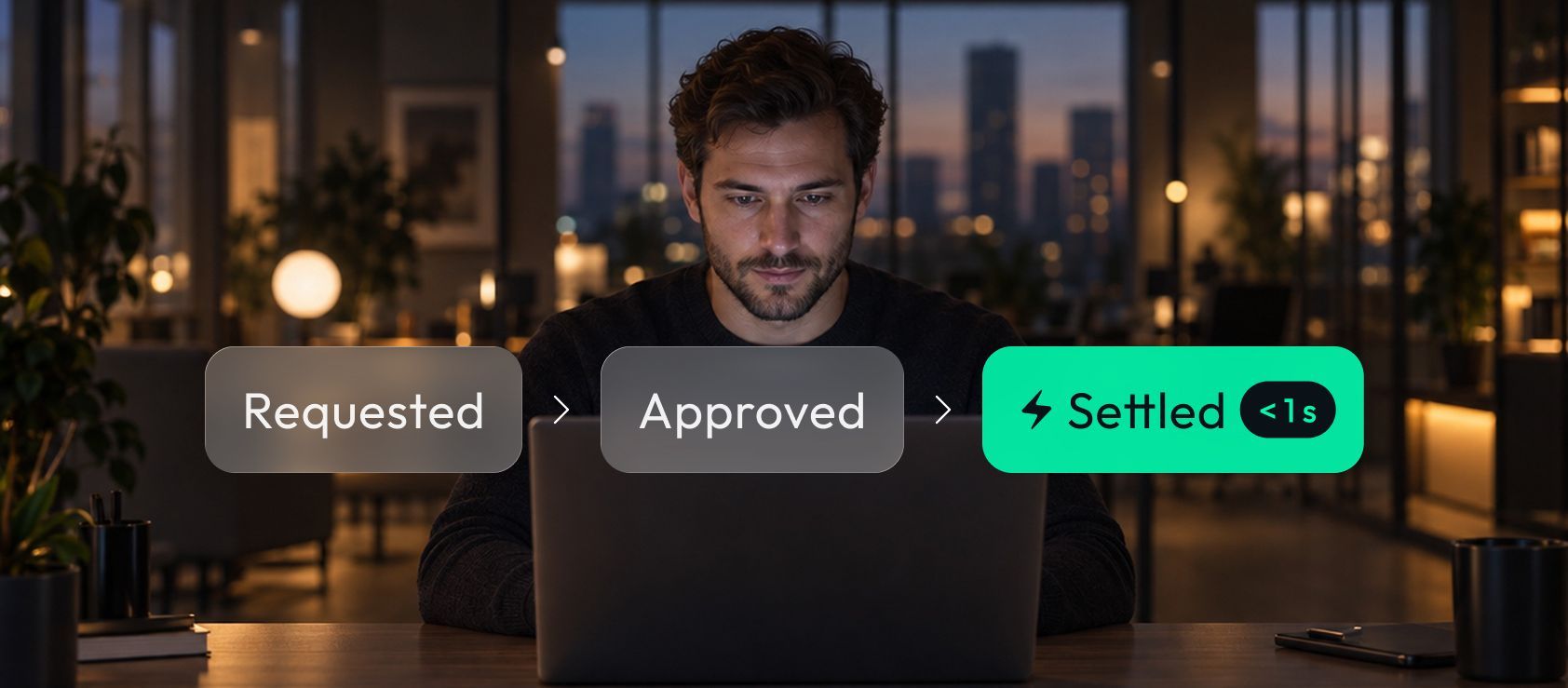
An instant crypto withdrawal is a payout that leaves the platform and becomes spendable in the user's wallet within seconds of approval, with no block confirmation wait. Most withdrawals are not instant because approval steps, batch schedules, and confirmations sit between the request and the arrival, not because the underlying network is slow.
Instant Crypto Withdrawal Explained
Users confuse the 3 states, and almost every complaint lives in the gap between the first 2. A withdrawal is requested when the user submits it, approved when risk and compliance checks clear, and settled when the funds are spendable at the destination. A payout marked as "pending" is usually between request and approval, in a policy queue rather than a network queue.
Platforms routinely describe withdrawals as fast while quoting help-centre ranges of anything from 30 minutes to 24 hours, and users read "instant" as seconds. Almost all of that spread comes from 4 causes: batch cut-offs on the paying rail, compliance and velocity review, block confirmations, and network congestion. The next section attributes a time cost to each.
This matters most to product, payments, and operations teams at licensed exchanges, marketplaces, fintech apps, digital services, and online entertainment platforms, all of which are judged on how quickly money leaves.
Crypto Withdrawal Time by Payment Rail: Where the Delay Comes From
Crypto withdrawal time depends on the chosen rail and the checks layered on top of it. The bank and card figures below are typical published ranges from the cited sources, not ElenPAY measurements.
| Rail | Typical arrival time | What causes the delay | Operating hours |
|---|---|---|---|
| Domestic bank transfer (Faster Payments) | Seconds at the scheme level, often hours end-to-end | Platform batch cut-offs, beneficiary bank posting, weekend and holiday windows | Scheme 24/7, platform batches usually work during working hours |
| SEPA and SEPA Instant | SEPA Instant within seconds; standard SEPA 1 business day | Scheme choice, reachability of the receiving bank, and cut-off times | SEPA Instant 24/7; standard SEPA business days |
| Card refund rails | Typically, 3 to 5 working days | Acquirer and issuer processing, refunds follow a different path from payments | Business days |
| On-chain Bitcoin | 10 minutes to several hours | Around 10-minute average block interval, 2 to 6 confirmations, fee market spikes | 24/7 |
| Lightning | Under 1 second | Outbound liquidity availability and routing | 24/7 |
Bank transfers are the clearest example of scheme speed being mistaken for payout speed. Faster Payments moves value in seconds, and TIPS does the same in euros, but if the platform releases payouts in a batch at 16:00 on working days, the user waits for the batch, not the scheme. Card refund rails are slower again because a refund is not a payment: consumer guidance from Which? puts the typical range at 3-5 working days.
On-chain Bitcoin adds a different cost. Blocks arrive roughly every 10 minutes, with considerable variance, as mempool data show, and most platforms wait for multiple confirmations before treating a payout as final. Rather than repeat the mechanics here, the detail on Bitcoin on-chain vs Lightning covers how confirmations work and where the wait comes from.
Compliance sits above all of it. UK firms carrying on cryptoasset activities must register with the FCA for anti-money-laundering supervision, and verification, sanctions screening, and velocity review happen before any rail is touched. That review, not the rail, is the most common cause of a 24-hour hold.
| Quick tip: Measure payout time from request timestamp to wallet-spendable timestamp. Measuring from batch release flatters the internal metric and hides the delay the user actually experiences. |
How Lightning Delivers Instant Bitcoin Payouts
Instant Bitcoin payouts work because the value has already been committed. On Lightning, funds sit in payment channels funded in advance, so paying a user is a rebalance between channel peers rather than a new transaction broadcast to the blockchain. Settlement happens off-chain and finalises immediately between the parties, which is why there is no confirmation wait. The mechanics of Lightning liquidity and pre-funded channels explain why capacity, not block space, is the real constraint.
The flow runs in a fixed order: the user requests a payout, the platform approves it against its risk rules, the user presents a Lightning invoice or uses LNURL-withdraw, the payment routes across channels, and the wallet balance updates. Each step after approval is measured in milliseconds.
ElenPAY supports both pay-ins and payouts on this model, with settlement in under 1 second and network fees below $0.01. The ElenPAY team manages nodes, liquidity, and custody, so platforms are not left operating channel infrastructure to keep payouts moving.
What a Platform Needs to Offer Instant Withdrawals
Instant payouts are an operating model, not a toggle. 5 things need to be in place.
- API automation. Payout requests are triggered programmatically once approval logic clears, rather than being queued for an operations team to release. A Bitcoin payment gateway API exposes the payout endpoints and status events needed to remove the manual step.
- Liquidity management. Either run and rebalance nodes internally, with the treasury and monitoring burden that implies, or use a payment service provider that manages nodes, liquidity, and custody.
- Risk controls that survive automation. Per-transaction and daily limits, velocity checks, first-withdrawal review, and destination allow-listing keep automated payouts inside defined tolerances.
- KYC and sanctions gating before approval. If verification is complete at approval, the payout rail is never the bottleneck.
- Webhook reconciliation. Settlement events written straight back to the ledger mean finance, support, and the user all see the same state.
Integration can run through a REST API, payment links, a checkout widget, or a white-label deployment, depending on how much of the withdrawal interface the platform wants to own. This article is general information and not legal, tax, or accounting advice.
Why Bitcoin Payout Speed Matters for Retention and Support
The withdrawal is the moment a user tests whether the platform genuinely holds their money. Deposits are easy to make and easy to forget; a payout that lands in seconds is direct evidence that funds are accessible, and that evidence shapes whether the next deposit happens.
It also removes a predictable support cost. "Where is my withdrawal" is one of the highest-volume contact types on any platform that pays users out, and it is generated almost entirely by the pending state. Remove the pending state, and the ticket has nothing to describe. Bitcoin payments also carry no chargebacks, which changes how disputes are handled compared with card rails.
Competitive parity is the final argument. Published ranges of 30 minutes to 24 hours are the benchmark users compare against, and a payout measured in seconds stands out as visibly different. A Bitcoin Lightning payment gateway puts pay-ins and payouts on the same rail, so the deposit and withdrawal experiences match.
Automate Instant Bitcoin Payouts with ElenPAY's Bitcoin Payment Gateway API
Licensed platforms can trigger instant crypto withdrawals programmatically and settle in under 1 second, with the ElenPAY team managing nodes, liquidity, and custody. A scoping call walks through the endpoints, webhooks, and payout flows required to move from a release queue to automated settlement, mapped against the platform's existing approval logic and payout volume.
To automate instant Bitcoin payouts, contact the ElenPAY team, and a specialist will confirm the integration route and API scope for your specific withdrawal flow.
Instant Crypto Withdrawals: FAQs
Why do some platforms hold withdrawals for review?
Holds are applied to meet anti-money-laundering obligations and to catch account takeover, stolen credentials, and unusual velocity. A first withdrawal, a new destination, or a sudden change in amount will commonly trigger manual review. The hold is a policy decision made before the payout rail is used, so the delay is unrelated to network speed.
Does a user need a specific wallet to receive an instant Bitcoin payout?
Any Lightning-enabled wallet will receive the payment. The user either generates a Lightning invoice for the withdrawal amount or uses an LNURL-withdraw link provided by the platform. No particular brand of wallet is required, and the funds are spendable as soon as the payment routes.
Can a platform automate instant Bitcoin payouts?
Yes. Payouts can be triggered by the API once the platform's approval logic clears, with webhook events confirming settlement in the ledger. Automation is safe only when limits, velocity checks, and verification gating run before the payout call is made.
Are there limits on instant crypto withdrawals?
Most platforms apply per-transaction ceilings, daily or rolling limits, and tiered thresholds linked to verification level. Outbound channel capacity can also cap the size of a single Lightning payout, which is why liquidity is continuously monitored and rebalanced. Limits are set by the platform and its provider rather than by the network itself.
Does an instant withdrawal cost more to process?
Not necessarily. Network fees on ElenPAY sit below $0.01, well under typical card refund and cross-border bank costs. The larger savings are usually operational: fewer manual releases, fewer reconciliation exceptions, and fewer support contacts regarding pending payments.