
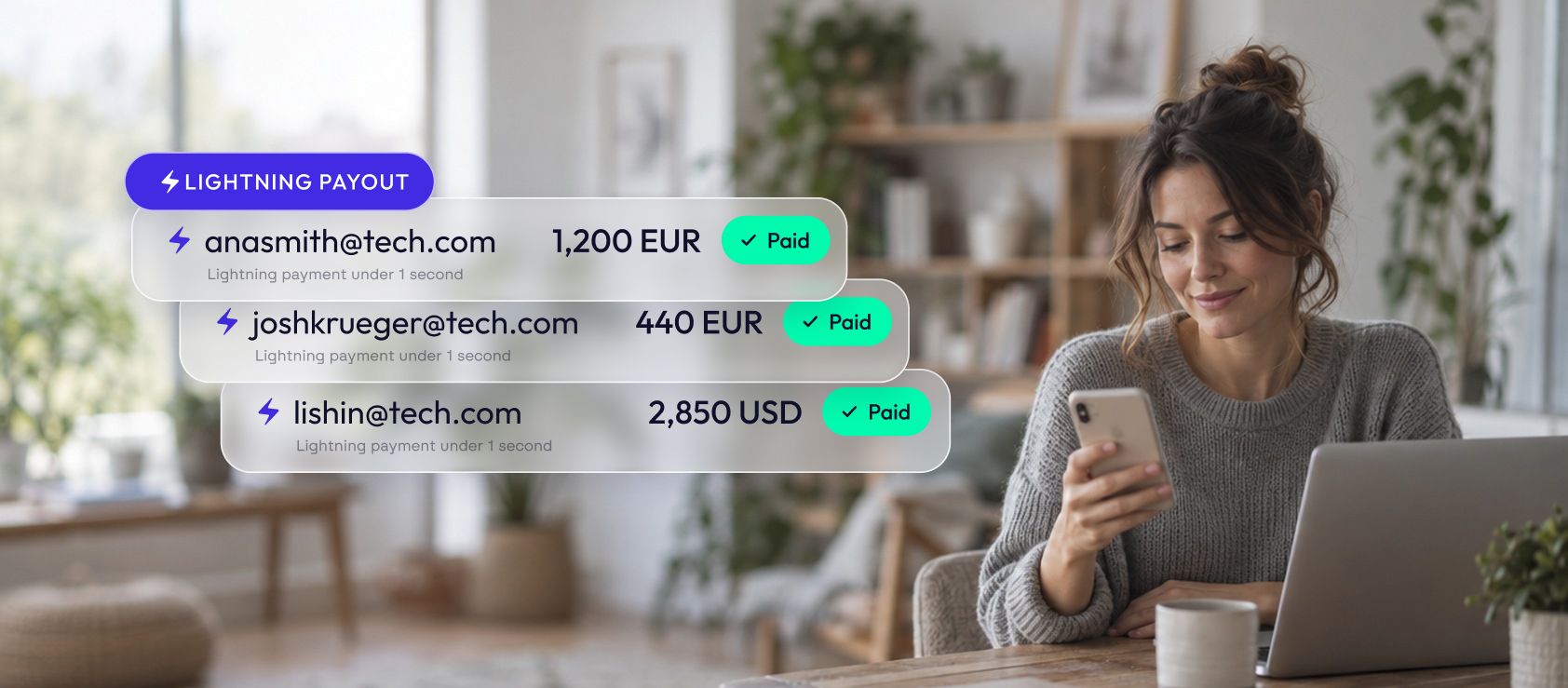
Paying contractors in Bitcoin over Lightning means settling an agreed-upon invoice amount to a recipient's Lightning address instead of routing it through bank rails. Crypto payroll set up this way suits businesses paying a distributed base of contractors, affiliates, sellers, or partners across several countries, because Bitcoin payroll gives finance 1 rail for every market.
What Does Crypto Payroll for Contractors Mean in Practice?
In practice, crypto payroll for a contractor base is a payout process: the business receives an invoice, converts the amount to bitcoin at an agreed rate, and settles it over the Lightning Network. Nothing about the commercial relationship changes. The invoice, the scope, and the approval chain stay where they are; only the settlement rail moves.
This guide covers contractor payouts and partner payouts, not employee salaries. Employment structures bring payroll taxes, statutory deductions, and employer-of-record questions that sit outside a payout rail, and this article is not tax, employment, or legal advice.
There are 2 moving parts. The recipient supplies a Lightning address or a Lightning invoice. The payer triggers the payout and receives a confirmation that records the amount, the time, and the destination. That confirmation is what finance files against the invoice.
Why Businesses Pay Contractors and Partners in Bitcoin
The case is operational rather than ideological, and it rests on 4 points.
Speed
ElenPAY settles in under 1 second, so a payout approved late on a Friday does not sit in a correspondent banking queue until Tuesday. For partner programmes paying weekly or on demand, that cuts out most of the "where is my money" support traffic.
Cost
Network fees on ElenPAY are below $0.01. Compare that with percentage-based international transfer pricing, which scales with the number and value of payouts, and the gap widens as the payee list grows.
Reach
A recipient needs a Lightning-enabled wallet, not a local bank account or card acceptance. That matters where account access is uneven: the World Bank's Global Findex 2025 data records 1.3 billion adults without an account, many of them in the markets where marketplace sellers and contractors sit.
1 Rail, Many Countries
Instead of maintaining separate bank files, card payout methods, and local schemes per market, finance runs 1 process. And because Lightning payouts carry no chargebacks, the reversal exposure that card rails carry does not arise.
Bitcoin Payouts vs Bank Transfers: Cost and Time Compared
| Payout Rail | Typical Cost | Typical Settlement Time | Recipient Requirement | Reversible |
|---|---|---|---|---|
| International bank transfer | Near 6% on the World Bank's $200 cross-border benchmark, plus lifting fees and FX spread | 1 to 5 business days | Bank account reachable by correspondent routing | Recall is possible, not guaranteed |
| Card payout | Percentage of value plus a fixed fee per payout | Minutes to several days by scheme and issuer | Card on a supported network | Possible under the scheme dispute rules |
| On-chain Bitcoin | Variable miner fee that rises with mempool demand | Roughly 10 minutes to over 1 hour for confirmations | Bitcoin address | No |
| Bitcoin over Lightning (ElenPAY) | Network fees below $0.01 | Under 1 second | Lightning address or invoice | No chargebacks |
The bank transfer cost and time ranges above track the World Bank's Remittance Prices Worldwide database, and settlement windows for correspondent routing are documented by Swift GPI. Percentage pricing does its real damage at high payout counts and low ticket sizes: 2,000 payouts of $40 each, priced at 5%, cost $4,000 in fees, while per-transfer minimums can exceed the payout itself. Flat, sub-cent network fees change the economics of paying small amounts frequently, which is the pattern most affiliate and seller programmes run on. For the mechanics behind that, see how Lightning reduces payment costs.
How to Pay Contractors in Bitcoin over Lightning, Step by Step
- Collect a Lightning address or invoice at onboarding. Store it against the payee record alongside the entity name, tax reference, and contact details, so no payout run starts with a chase.
- Agree on the invoicing currency, rate source, and timestamp. Most contractors invoice in a fiat unit. Fix which rate feed converts that amount to bitcoin, and at which moment the rate is struck.
- Trigger the payout. Run it from the dashboard for occasional payees, or through the Bitcoin payment gateway API for payouts driven by a billing or commission system. Payouts are triggered individually, which keeps each one tied to 1 approved invoice.
- Take webhook confirmation as the settlement record. Write the status back to the accounting or billing system automatically so the invoice closes without manual reconciliation. The same pattern underpins instant crypto withdrawals on Lightning.
- Export the payout record. Amount invoiced, amount settled in bitcoin, rate source, timestamp, recipient reference, and confirmation ID should all be included in the same export.
| Quick tip: Ask for a reusable Lightning address rather than a fresh invoice each cycle. A static address removes a round trip from every payout run and stops payments stalling on expired invoices. |
What to Put in the Contractor Agreement and Payout Policy
Most failed first payouts are due to paperwork, not technical issues. Cover these points before the first run:
- Currency of invoice and currency of settlement, stated separately. An invoice denominated in euros settled in bitcoin is a normal arrangement, but the contract has to say so.
- Rate source and timestamp. Name the feed and the exact moment used, for example, the rate at payout trigger rather than at invoice receipt.
- Who bears the network fee. State whether the payout is gross or net of it, even where the amount is negligible.
- Minimum payout threshold and cadence. Weekly, fortnightly, or on demand, with a floor below which balances roll forward.
- Dispute and re-issue handling. What happens when a payout fails against a stale address, who reissues it, and within what window?
- Notification duties. A change of Lightning address or entity status should be notified with a defined notice period before the next run.
What Contractors and Freelancers Need to Receive Bitcoin Payouts
Any Lightning-enabled wallet or Lightning address is enough to receive a payout. There is no application, no account opening with the payer's bank, and no card requirement.
From the contractor's side, the process is short: share the address once, keep it on file with the payer, and funds arrive in seconds with immediate confirmation. Contractors who want local currency converted through a provider of their own choosing, and the timing of that conversion is their decision rather than the payer's.
Volatility is narrower than it first looks. Invoicing in a fiat unit and settling in bitcoin at a timestamped rate limits exposure to the conversion window, usually seconds, not to holding bitcoin afterwards. Recipients should keep the invoice, the rate applied, and the settlement confirmation for local tax reporting.
Compliance and Record Keeping for Bitcoin Payroll
The controls are the ones finance already applies to payees, applied to a different rail. Verify each recipient at onboarding: identity, entity status, and ownership of the payout address. Screen payees against sanctions and watchlists before the first payout and on an ongoing basis, not once at sign-up.
Per payout, retain the invoice, converted amount, rate source, timestamp, settlement confirmation, and recipient reference. Held together, those 5 items reconstruct any payout years later and keep records sufficient for local tax reporting.
Where transfers pass between regulated intermediaries, transfer-of-information obligations apply under the FATF standards, updated in the 2024 targeted update on virtual assets. The details sit in a separate guide to the Travel Rule and Bitcoin payments.
Build contractor and partner payouts on ElenPAY's Bitcoin payment gateway API. Collect a Lightning address during onboarding, trigger the payout, and use the webhook confirmation as the settlement record. The ElenPAY team manages nodes, liquidity, and custody, so finance handles approvals and records rather than infrastructure.
Book a Technical Walkthrough for Contractor and Partner Payouts
Contractor and partner payouts on ElenPAY run through address collection at onboarding, a triggered payout call, and a webhook confirmation as the settlement record. The ElenPAY team manages nodes, liquidity, and custody, so finance handles approvals and records rather than infrastructure.
A technical walkthrough maps contractor payouts, partner payouts, and crypto payroll onto Lightning, from address collection through to exportable payout records, against the specific billing or commission system already in place.
To book a technical walkthrough, contact the ElenPAY team, and a specialist will map the payout flow end to end.
Crypto Payroll: FAQs
Can a business legally pay contractors in Bitcoin?
It depends on the jurisdiction and on what the contract says. Many countries permit settlement in bitcoin where both parties agree in writing and the business keeps records adequate for local tax reporting. Confirm the position with local counsel, as this is not legal advice.
Can contractors invoice in USD and be paid in Bitcoin?
Yes, and it is the most common arrangement. The invoice is denominated in dollars, the agreement names the rate source and the timestamp at which conversion is struck, and the bitcoin amount follows from that. Both parties then have the same reference figures for reconciliation.
Who pays the network fee on a Bitcoin payout?
Whichever party the agreement names. Lightning network fees on ElenPAY are below $0.01, so the amount is immaterial either way, but the policy should still say whether payouts are gross or net of it.
Who bears the exchange rate risk on a Bitcoin payout?
The party the contract assigns it to. The real exposure is the conversion window between striking the rate and settling the payout, and a timestamped rate with sub-second settlement narrows that window to almost nothing.