
Does the crypto bear market affect the Bitcoin Lightning Network?
Crypto markets move in cycles. They go from periods of euphoric growth and liquidity inflows (crypto bull market) to phases of correction and consolidation (crypto bear market). These bull and bear markets tend to dominate the narrative, often leading to the assumption that network usage and infrastructure development rise and fall in tandem with price.
But that assumption doesn’t hold up, especially when it comes to the Bitcoin Lightning Network. As a Layer 2 protocol, Lightning operates on a fundamentally different dynamic. It makes Bitcoin scalable, fast, and usable for real-world payments. Like any robust infrastructure layer, utility, performance, and long-term adoption trends dictate its relevance.
Here’s a breakdown of how market cycles work, where we are today, and why the Lightning Network and the businesses building on top of it are largely insulated from speculative noise.

What are bull and bear markets in crypto?
Bull and bear markets are fundamental components of any asset class, and crypto is no exception. Analysts typically define a crypto bull market by sustained price growth, increased investor confidence, higher trading volumes, and capital inflows. Favorable macro conditions, technological innovation, institutional adoption, or regulatory clarity often fuel these periods.
On the other hand, a crypto bear market shows prolonged price declines, reduced liquidity, and broader risk aversion across the ecosystem. In crypto, this often coincides with regulatory pressure, macro tightening, or the unwinding of speculative excess from previous cycles.
Importantly, these cycles reflect broader market structure and macroeconomic forces, from interest rates to monetary policy to geopolitical risk.
Are we in a crypto bear market?
As of late 2025, the market is in a transitional phase, with indicators that the bear market could end soon. Following a surge in institutional activity, ETF approvals, and the post-halving narrative, Bitcoin experienced significant inflows. But also a subsequent correction. While price action has cooled, the underlying infrastructure, including Lightning, continues to mature.
This context is essential when evaluating whether protocols like Lightning are truly dependent on market conditions, or whether they operate on a different trajectory altogether.
Lightning is core to Bitcoin’s long-term utility
The Lightning Network was developed to address Bitcoin’s scalability bottleneck. At its core, the Bitcoin base layer prioritizes security, decentralization, and censorship resistance. However, the costis limited throughput and higher settlement latency. In other words, it is not fast.
Lightning doesn’t change Bitcoin’s base layer; it builds on top of it. It enables instant, low-cost transactions by creating payment channels between participants. These channels allow for off-chain settlement. The result is a highly efficient, peer-to-peer payment system capable of processing thousands of transactions per second with minimal fees.
From store of value to medium of exchange
For businesses, payment processors, and platforms exploring Bitcoin integration, Lightning shifts Bitcoin from a static store of value to a dynamic medium of exchange. And it does so without compromising on final settlement security. This is critical for use cases requiring speed, microtransaction capabilities, or operational efficiency across borders.
Moreover, Lightning enhances the end-user experience: payments are instant, fees are as low as 0.01%, and UX is greatly improved. Bitcoin’s price performance doesn’t determine these benefits. Instead, they are tied to network maturity, protocol development, and enterprise adoption. And these factors continue to evolve through all market conditions.
Bitcoin Lightning adoption beyond the crypto bear market
Lightning’s momentum continues to build consistently, despite Bitcoin’s price fluctuation. As of December 9th 2025, over 5,340 BTC are locked in Lightning channels. That is a 15% increase in network capacity over the last 30 days and a strong reflection of long-term confidence.
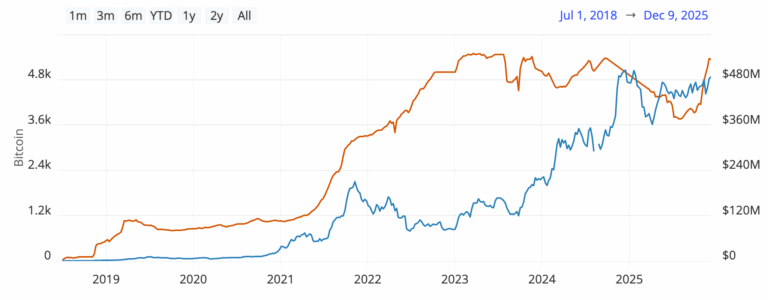
The network is maturing, as major infrastructure and financial services providers are embracing Lightning as a serious payment rail. Lightning now supports tens of thousands of nodes and infrastructures that aim to deliver the same payment‑rail reliability as traditional systems.
This institutional momentum matters because it means that Lightning is becoming part of the broader financial system infrastructure. As more exchanges, wallets, and payment platforms integrate Lightning for deposits, withdrawals, and transfers, the network’s growth becomes tied to real transaction demand rather than speculative capital flows.
Regulatory environments are also evolving in Lightning’s favor
In many jurisdictions, evolving regulatory frameworks for crypto assets have created a legal environment in which Lightning‑based payments can be offered at scale under regulated conditions. Regulators are beginning to distinguish between speculative crypto assets and infrastructure protocols like Lightning. This distinction is especially positive for enterprise and global adoption.
Lightning use cases that don’t care about market sentiment
The long-term importance of the Lightning Network is further cemented by its growing real-world applications. Utility drives these use cases because they are active, practical, and solve real business challenges across borders, verticals, and transaction models.
Here are just a few use cases where Lightning is already proving its value, regardless of where the Bitcoin price sits:
- Instant and cheap global payments: Lightning enables instant Bitcoin transfers across borders, with settlement finality in seconds and near-zero fees.
- Microtransactions and high-frequency payments: Lightning’s low cost and speed make it ideal for models that are inefficient or unfeasible with traditional systems (streaming payments, pay-per-use digital services, frequent user deposits and withdrawals).
- Operational efficiency in emerging markets: In regions where banking access is limited or local currencies are unstable, Lightning offers a fast, dollar-accessible alternative that doesn’t require full banking infrastructure.
- Embedded financial infrastructure: Because Lightning operates 24/7, with no intermediaries or chargebacks, it functions as a programmable settlement layer ideal for automating payouts, commissions, or multi-party splits in real time.
Why ElenPAY builds on Lightning
The Lightning Network is maturing into a global payments layer, and it’s not waiting for the next bull market to prove its worth. It’s already delivering real-time, borderless, settlement-grade payments that outperform legacy systems in speed, cost, and flexibility.
At ElenPAY, we’re building on Lightning because it solves our clients’ persistent challenges:
- Slow or delayed settlement times
- High transaction fees eating into margins
- Limited access to cross-border markets
- Friction with legacy payment infrastructure
Our enterprise-ready solution removes the complexity of managing liquidity, routing, or compliance, so businesses can focus on what matters: faster payments, better user experience, and entering new markets with confidence.
Ready to upgrade your payments stack? Book a demo and let’s talk about how ElenPAY can help you integrate Lightning and start leveraging Bitcoin as a serious, scalable payment rail.